
Mercedes-Benz GLC : Mercedes-Benz emergency call system / Overview of the Mercedes-Benz emergency call system
eCall can help to reduce the time between an accident and the arrival of emergency services at the site of the accident. It helps locate an accident site in places that are difficult to access. However, even if a vehicle is equipped with eCall, this does not mean the system is ON. As such, eCall does not replace dialing 911 in the event of an accident.
An emergency call can be made automatically or manually Only make emergency calls if you or others are in need of rescue.
Only make emergency calls if you or others are in need of rescue. Do not make an emergency call in the event of a breakdown or a similar situation.
Messages on the display
SOS NOT READY: the ignition is not on or eCall not available.
During an active emergency call,  appears
in the display.
appears
in the display.
You can find more information on the regional availability of eCall at: https://www.mercedesbenz-mobile.com/extra/ecall/
If there is a malfunction in the Mercedes- Benz emergency call system (e.g. a fault with the speaker, microphone, airbag, SOS button), a corresponding message appears in the multifunction display of the instrument cluster.
 Information on the Mercedes-Benz emergency call system
Your vehicle is equipped with the Mercedes-Benz
emergency call system ("eCall"). This feature can
help save lives in the event of an accident. eCall
in no way replaces assistance provided from
dialing 911...
 Triggering an automatic Mercedes‑Benzemergency call
Requirements:
The ignition is switched on.
The starter battery is sufficiently charged.
The Mercedes‑Benz emergency call system triggers
an emergency call automatically in the following
cases:
After activation of the restraint systems such
as airbags or Emergency Tensioning Devices
after an accident
After an automatically initiated emergency
stop by Active Emergency Stop Assist
The emergency call has been made:
A voice connection is made to the
Mercedes‑Benz emergency call center...
Other information:
Mercedes-Benz GLC 2016-2026 Owners Manual: Pulling away with Active Distance Assist DISTRONIC
Activate Active Distance Assist DISTRONIC and remove your foot from the brake pedal. Select with the left rocker switch. or Depress the accelerator pedal briefly and firmly. The functions of Active Distance Assist DISTRONIC continue to be carried out...
Mercedes-Benz GLC 2016-2026 Owners Manual: Overview of displays on the multifunction display
Displays on the multifunction display Active Parking Assist activated Parking Assist PARKTRONIC deactivated Cruise control DSR Active Distance Assist DISTRONIC Active Brake Assist Active Steering Assist Active Lane Keeping Assist Active Lane Change Assist ECO start/stop function HOLD function Adaptive Highbeam Assist Vehicles with Traffic Sign Assist: Detected instructions and traffic signs...
Categories
- Manuals Home
- Mercedes-Benz GLC Owners Manual
- Mercedes-Benz GLC Service Manual
- Activating or deactivating the child safety lock for the rear doors
- Removing the cargo compartment cover
- Digital Operator's Manual
- New on site
- Most important about car
Unlocking/opening the doors from the inside
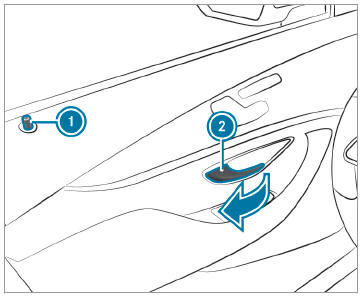
 To unlock and open a front
door: pull door
handle
To unlock and open a front
door: pull door
handle  .
.
