
Mercedes-Benz GLC : Wheels and tires / Notes on regularly inspecting wheels and tires
WARNING Risk of injury through damaged tires
Damaged tires can cause tire pressure loss.
 Check the tires regularly
for signs of
damage and replace any damaged tires
immediately.
Check the tires regularly
for signs of
damage and replace any damaged tires
immediately.
WARNING Risk of hydroplaning due to insufficient tire tread
Insufficient tire tread will result in reduced tire grip.
In heavy rain or slush the risk of hydroplaning is increased, in particular where speed is not adapted to suit the conditions.
 Thus, you should
regularly check the
tread depth and the condition of the
tread across the entire width of all tires.
Thus, you should
regularly check the
tread depth and the condition of the
tread across the entire width of all tires.
Minimum tread depth for:
- Summer tires: â in (3 mm)
- M+S tires: ãin (4 mm)
 For safety reasons,
replace the tires
before the legally-prescribed limit for
the minimum tread depth is reached.
For safety reasons,
replace the tires
before the legally-prescribed limit for
the minimum tread depth is reached.
Carry out the following checks on all wheels regularly, at least once a month or as required, for example, prior to a long journey or driving offroad:
- Check the tire pressure.
- Visually inspect wheels and tires for damage.
- Check the valve caps.
- Visual check of the tire tread depth and the tire contact surface across the entire width. The minimum tread depth for summer tires is â in (3 mm) and for winter tires ã in (4 mm).
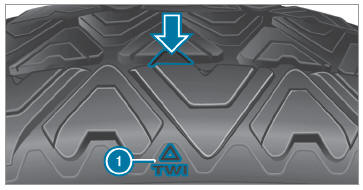
Six marks
 show where the bar indicators
(arrow) are integrated into the tire tread. They
are visible once a tire tread depth of approximately
1/16 in (1.6 mm) has been reached.
show where the bar indicators
(arrow) are integrated into the tire tread. They
are visible once a tire tread depth of approximately
1/16 in (1.6 mm) has been reached.
 Notes on noise or unusual handling characteristics
Make sure there are no vibrations, noises or
unusual handling characteristics when the vehicle
is in motion. This may indicate that the
wheels or tires are damaged...
 Notes on snow chains
WARNING Risk of accident due to incorrect
mounting of snow chains
If you have mounted snow chains to the front
wheels, the snow chains may drag against
the vehicle body or chassis components...
Other information:
Mercedes-Benz GLC 2016-2026 Owners Manual: Using the TIREFIT kit
Requirements: Tire sealant bottle and tire inflation compressor. TIREFIT sticker Gloves (depending on the vehicle equipment) You can use TIREFIT tire sealant to seal perforation damage of up to 0.16 in (4 mm), particularly those in the tire contact surface...
Mercedes-Benz GLC 2016-2026 Owners Manual: Overview of displays on the multifunction display
Displays on the multifunction display Active Parking Assist activated Parking Assist PARKTRONIC deactivated Cruise control DSR Active Distance Assist DISTRONIC Active Brake Assist Active Steering Assist Active Lane Keeping Assist Active Lane Change Assist ECO start/stop function HOLD function Adaptive Highbeam Assist Vehicles with Traffic Sign Assist: Detected instructions and traffic signs...
Categories
- Manuals Home
- Mercedes-Benz GLC Owners Manual
- Mercedes-Benz GLC Service Manual
- Activating or deactivating the child safety lock for the rear doors
- Removing the cargo compartment cover
- Folding the rear seat backrest forwards
- New on site
- Most important about car
Activating/deactivating the panic alarm
Requirements:
The ignition is switched off.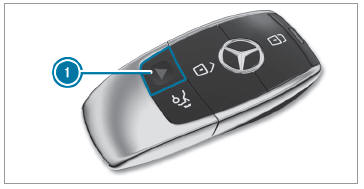
 To activate: press button
 for approximately one second.
