Mercedes-Benz GLC : Driving and driving safety systems / Functions of ESP®
WARNING Risk of skidding if ESP® is deactivated
If you deactivate ESP®, ESP® cannot carry out vehicle stabilization.
 ESP® should only be
deactivated in the
following situations.
ESP® should only be
deactivated in the
following situations.
NOTE Mercedes-AMG vehicles
 Observe the notes in the
Supplement.
You could otherwise fail to recognize
dangers.
Observe the notes in the
Supplement.
You could otherwise fail to recognize
dangers.
The Electronic Stability Program (ESP®) can monitor and improve driving stability and traction in the following situations within physical limits:
- When pulling away on a wet or slippery road.
- When braking.
If the vehicle deviates from the direction desired by the driver, ESP® can stabilize the vehicle by intervening in the following ways:
- One or more wheels are braked.
- The engine output is adapted according to the situation.
ESP® is deactivated if the  ESP®
OFF warning
lamp lights up continuously in the instrument
cluster:
ESP®
OFF warning
lamp lights up continuously in the instrument
cluster:
- Driving stability will no longer be improved.
- The drive wheels could spin.
- ETS/4ETS traction control is still active.
When ESP® is deactivated, you are still assisted by ESP® when braking.
If the  ESP® warning lamp
flashes in the
instrument cluster, one or several wheels has
reached its grip limit:
ESP® warning lamp
flashes in the
instrument cluster, one or several wheels has
reached its grip limit:
- Adapt your driving style to suit the current road and weather conditions.
- Do not deactivate ESP®.
- Only depress the accelerator pedal as far as is necessary when pulling away.
It can be advantageous to deactivate ESP® in the following situations to improve traction:
- When using snow chains.
- In deep snow.
- On sand or gravel.
Spinning the wheels results in a cutting action, which enhances traction.
If the  ESP® warning lamp lights
up continuously,
ESP® is not available due to a malfunction.
ESP® warning lamp lights
up continuously,
ESP® is not available due to a malfunction.
Observe the following information:
- Indicator and warning lamps
- Display messages
ETS/4ETS (Electronic Traction System)
ETS/4ETS traction control is part of ESP® and makes it possible to pull away and accelerate on a slippery road.
ETS/4ETS can improve the vehicle's traction by intervening in the following ways:
- The drive wheels are braked individually if they spin.
- More drive torque is transferred to the wheel or wheels with traction.
Influence of drive programs on ESP®
The drive programs enable ESP® to adapt to different weather and road conditions as well as the driver's preferred driving style. Depending on the selected drive program, the appropriate ESP® mode will be activated. You can select the drive programs using the DYNAMIC SELECT switch.
 Function of BAS
The Brake Assist System (BAS) supports your
emergency braking situation with additional
brake force.
If you depress the brake pedal quickly, BAS is
activated:
BAS automatically boosts the brake pressure...
 Function of ESP® Crosswind Assist and ESP® trailer stabilization
Function of ESP® Crosswind Assist
ESP® Crosswind Assist detects sudden gusts of
side wind and helps the driver to keep the vehicle
in the lane:
ESP® Crosswind Assist is active at vehicle
speeds between approx...
Other information:
Mercedes-Benz GLC 2016-2026 Owners Manual: Telephony
Notes on telephony WARNING Risk of distraction from operating integrated communication equipment while the vehicle is in motion If you operate communication equipment integrated in the vehicle when driving, you could be distracted from the traffic situation...
Mercedes-Benz GLC 2016-2026 Owners Manual: Mercedes me calls
Making a call via the overhead control panel me button for service or information calls SOS button cover SOS button (emergency call system) Making a Mercedes me call Press me button . Making an emergency call To open the cover of SOS button , press it briefly...
Categories
- Manuals Home
- Mercedes-Benz GLC Owners Manual
- Mercedes-Benz GLC Service Manual
- Overview of buttons on the steering wheel
- Using the 12 V socket
- Information on collision detection on a parked vehicle
- New on site
- Most important about car
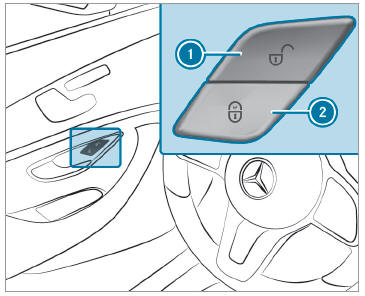
Activating/deactivating the automatic locking feature
The vehicle is locked automatically when the ignition is switched on and the wheels are turning faster than walking pace.