Mercedes-Benz GLC : Engine compartment / Checking the coolant level
WARNING Risk of burns from hot component parts in the engine compartment
Certain component parts in the engine compartment can be very hot, e.g. the engine, the cooler and parts of the exhaust system.
 Allow the engine to cool
down and only
touch component parts described in
the following.
Allow the engine to cool
down and only
touch component parts described in
the following.
WARNING Risk of scalding from hot coolant
If you open the cap, you could be scalded.
 Let the motor cool down
before opening
the cap.
Let the motor cool down
before opening
the cap.
 When opening the cap,
wear protective
gloves and safety glasses.
When opening the cap,
wear protective
gloves and safety glasses.
 Open the cap slowly to
release pressure.
Open the cap slowly to
release pressure.
 Park the vehicle on a level
surface.
Park the vehicle on a level
surface.
 Check the coolant temperature
display in the
instrument cluster.
Check the coolant temperature
display in the
instrument cluster.
The coolant temperature must be in the bottom quarter of the temperature display.
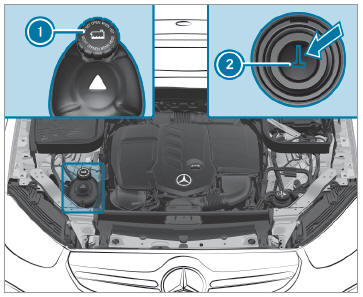
 Slowly turn cap
 counter-clockwise to
release overpressure.
counter-clockwise to
release overpressure.
 Continue turning cap 1
counter-clockwise
and remove it.
Continue turning cap 1
counter-clockwise
and remove it.
The coolant level is correct in the following cases:
- If the engine is cold, the coolant is up to
marker bar
 .
. - If the engine is warm, the coolant is up to
0.6 in (1.5 cm) over the marker bar
 .
.
 If necessary, add coolant that
has been
approved for Mercedes-Benz.
If necessary, add coolant that
has been
approved for Mercedes-Benz.
Further information on coolant
 Refilling engine oil
WARNING Risk of burns from hot component
parts in the engine compartment
Certain component parts in the engine compartment
can be very hot, e.g. the engine,
the cooler and parts of the exhaust system...
 Refilling the windshield washer system
WARNING Risk of burns from hot component
parts in the engine compartment
Certain component parts in the engine compartment
can be very hot, e.g. the engine,
the cooler and parts of the exhaust system...
Other information:
Mercedes-Benz GLC 2016-2026 Owners Manual: ECO display function
The ECO display summarizes your driving characteristics from the start of the journey to its completion and assists you in achieving the most economical driving style. You can influence consumption by doing the following: Driving with particular care Driving the vehicle in drive program Observing the gearshift recommendations The inner segment will light up and the outer segment will fill up when the following driving style is adopted: Moderate acceleration Gentle deceleration and rolling Consistent speed The inner segment will not light up and the outer segment will empty when the following driving style is adopted: Sporty acceleration Heavy braking Fluctuations in speed The ECO display will show you when you have driven economically: The three outer segments are completely filled simultaneously...
Mercedes-Benz GLC 2016-2026 Owners Manual: DSR (Downhill Speed Regulation)
Function of DSR (Downhill Speed Regulation) DSR is an aid to assist you when driving downhill. It keeps the speed of travel at the selected target speed. The steeper the downhill gradient, the greater the DSR braking effect on the vehicle. On flat stretches of road and uphill gradients, the DSR brakes the vehicle minimally or not at all...
Categories
- Manuals Home
- Mercedes-Benz GLC Owners Manual
- Mercedes-Benz GLC Service Manual
- Overview of the traffic light data service
- Opening the camera cover of the rear view camera
- Information on vehicle sensors and cameras
- New on site
- Most important about car
Fastening and adjusting seat belts
If the seat belt is pulled quickly or sharply, the seat belt retractor locks. The seat belt strap cannot be pulled out any further.