
Mercedes-Benz GLC 2016-2026 Owners Manual / Light and visibility / Mirrors / Automatic anti-glare mirrors function
Mercedes-Benz GLC : Mirrors / Automatic anti-glare mirrors function
WARNING Risk of acid burns and poisoning due to the anti-glare mirror electrolyte
Electrolyte may escape if the glass in an automatic anti-glare mirror breaks.
The electrolyte is hazardous to health and causes irritation. It must not come into contact with your skin, eyes, respiratory organs or clothing or be swallowed.
 If you come into
contact with electrolyte, observe the following:
If you come into
contact with electrolyte, observe the following:
- Immediately rinse the electrolyte from your skin with water and seek medical attention.
- If electrolyte comes into contact with your eyes, immediately rinse them thoroughly with clean water and seek medical attention.
- If the electrolyte is swallowed, immediately rinse your mouth out thoroughly. Do not induce vomiting. Seek medical attention immediately.
- Immediately change out of clothing which has been contaminated with electrolyte.
- If an allergic reaction occurs, seek medical attention immediately.
- The inside rearview mirror and the outside mirror on the driver's side will automatically go into anti-glare mode if light from a headlamp hits the sensor on the inside rearview mirror.
System limits
The system will not go into anti-glare mode if:
- The engine is switched off.
- Reverse gear is engaged.
- The interior lighting is switched on.
 Operating the outside mirrors
WARNING Risk of accident due to
adjusting the vehicle settings while the
vehicle is in motion
You could lose control of the vehicle in the
following situations in particular:
If you adjust the driver's seat, the head
restraint, the steering wheel or the mirror
while the vehicle is in motion
If you fasten your seat belt while the vehi‐
cle is in motion
Before starting the
engine: In particular,
adjust the driver's seat, head restraint,
steering wheel and mirror, and fasten
your seat belt...
 Front-passenger outside mirror parking position function
The parking position makes parking easier.
The front-passenger outside mirror will swivel
downwards in the direction of the rear wheel on
the front passenger's side when:
The parking position is stored...
Other information:
Mercedes-Benz GLC 2016-2026 Owners Manual: Manufacturer's services
Regarding the manufacturer's online services, the individual functions are described by the manufacturer in a suitable place, for example, in the Operator's Manual or on the manufacturer's website, where the relevant data protection information is also given...
Mercedes-Benz GLC 2016-2026 Owners Manual: Notes on driving on salt-treated roads
T..
Categories
- Manuals Home
- Mercedes-Benz GLC Owners Manual
- Mercedes-Benz GLC Service Manual
- Raising the vehicle when changing a wheel
- Information on vehicle sensors and cameras
- Removing the cargo compartment cover
- New on site
- Most important about car
HANDS-FREE ACCESS function
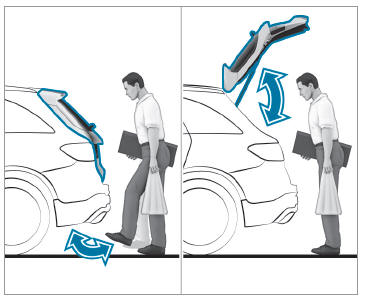
With HANDS-FREE ACCESS you can open, close or stop the closing process of the tailgate by performing a kicking movement under the rear bumper.
The kicking movement triggers the opening or closing process alternately.
Observe the notes when opening and closing the tailgate.

Copyright © 2026 www.meglc.net