
Mercedes-Benz GLC : Detecting risks, avoiding danger / Securing systems for child restraint systems in the vehicle
Only use the following securing systems for child restraint systems:
- The LATCH-type (ISOFIX) securing rings
- The vehicle's seat belt system
- The Top Tether anchorages
Installing a LATCH-type (ISOFIX) child restraint system is preferred.
Simply attaching to the securing rings on the vehicle can reduce the risk of installing the child restraint system incorrectly.
When securing a child with the integrated seat belt of the LATCH-type (ISOFIX) child restraint system, always comply with the permissible gross weight for the child and child restraint system.
A booster seat may be necessary to achieve proper seat belt positioning for children over 40 lbs (18 kg) in weight or until they reach a height where a three-point seat belt can be installed properly without a booster seat.
Mercedes-Benz recommends a suitable child booster seat with a backrest and seat belt guide.

 Advantage of a rearward-facing child restraint system
It is preferable to transport a baby or a small
child in a suitable rearward-facing child restraint
system. In this case, the child sits in the opposite
direction to the direction of travel and faces
backwards...
Other information:
Mercedes-Benz GLC 2016-2026 Owners Manual: Cornering light
Cornering light function The cornering light improves the illumination of the road over a wide angle in the turning direction, enabling better visibility on tight curves, for example. It can be activated only when the low beam is switched on. The function is active in the following cases: At speeds below 25 mph (40 km/h) when the turn signal light is switched on or the steering wheel is turned At speeds between 25 mph (40 km/h) and 43 mph (70 km/h) and when the steering wheel is turned Roundabout and intersection function: the cornering light will be activated on both sides based on an evaluation of the vehicle's current GPS position...
Mercedes-Benz GLC 2016-2026 Owners Manual: Notes on the correct driver's seat position
WARNING Risk of accident due to adjusting the vehicle settings while the vehicle is in motion You could lose control of the vehicle in the following situations in particular: If you adjust the driver's seat, the head restraint, the steering wheel or the mirror while the vehicle is in motion If you fasten your seat belt while the vehicle is in motion Before starting the engine: In particular, adjust the driver's seat, head restraint, steering wheel and mirror, and fasten your seat belt...
Categories
- Manuals Home
- Mercedes-Benz GLC Owners Manual
- Mercedes-Benz GLC Service Manual
- Replacing the rear window wiper blade
- Sound settings
- Overview of airbags
- New on site
- Most important about car
Adjusting the steering wheel electrically
The steering wheel can be adjusted when the power supply is disconnected.
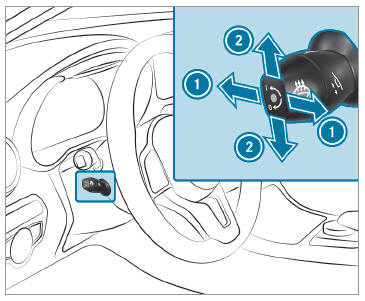
 To adjust the distance to the
steering wheel
To adjust the distance to the
steering wheel
